
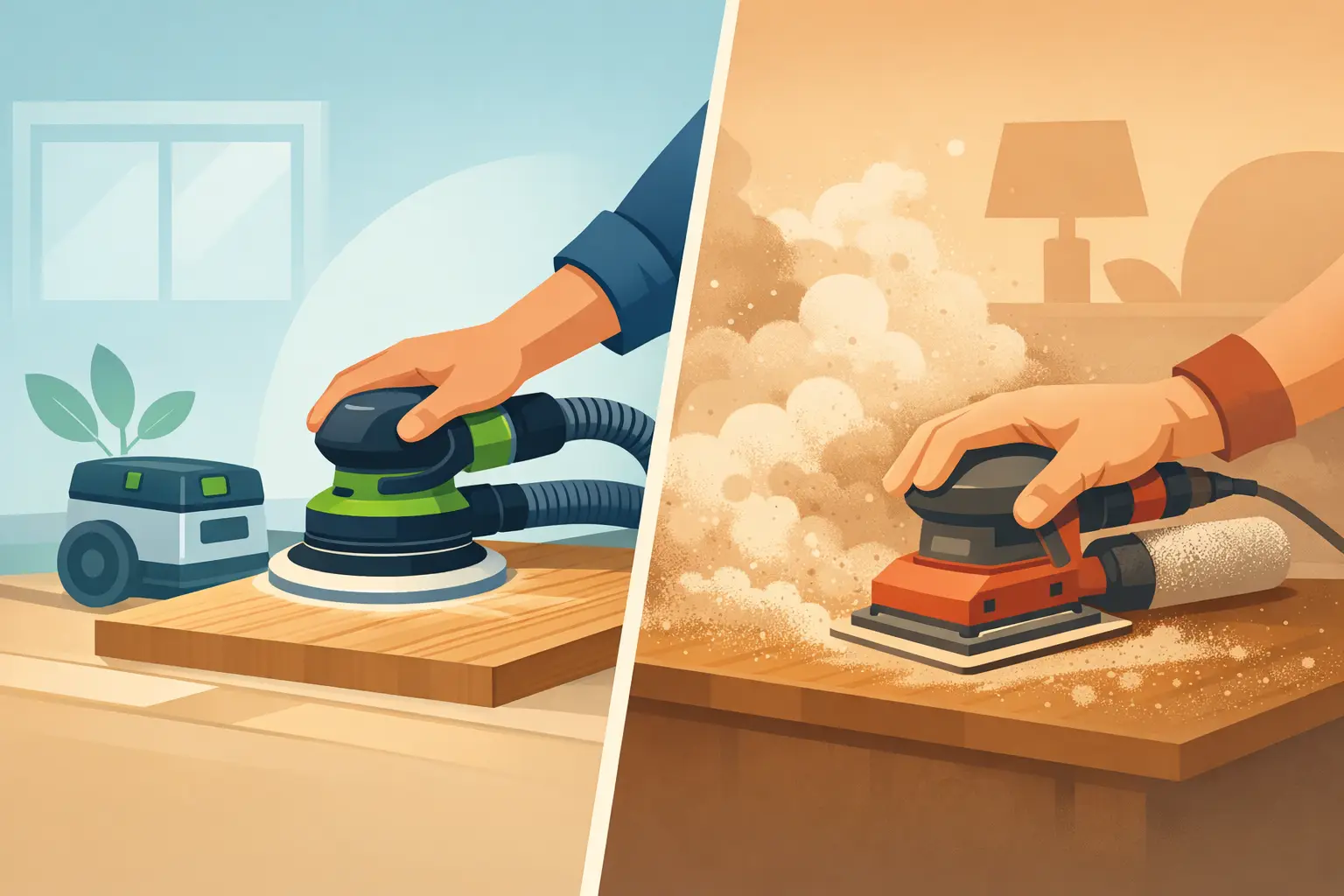
If you have ever seen a home during an old-style floor refinishing job, you probably remember the dust first. It settles on trim, furniture, vents, and just about every surface nearby. That is why homeowners often ask about dustless sanding vs traditional sanding before they commit to refinishing hardwood floors. The difference is not just about cleanup. It affects how your home feels during the project, how well the work is controlled, and how much disruption you live with while your floors are being restored.
For many homeowners, especially in lived-in homes, sanding method matters almost as much as stain color or finish sheen. A beautiful floor is the goal, but the process getting there matters too.
What separates dustless sanding from traditional sanding?
Traditional sanding uses standard floor sanding equipment that removes the old finish and smooths the wood, but it releases a large amount of airborne dust into the home. Contractors may hang plastic and do basic containment, but fine particles still tend to travel. That has long been accepted as part of refinishing, even though it creates more mess and more cleanup.
Dustless sanding uses sanding equipment connected to high-powered vacuum systems that capture dust at the source. No sanding process is literally zero dust, and any contractor who says otherwise is overselling it. But the reduction is significant. In a well-managed project, most of the dust is collected before it spreads through the room and beyond.
That distinction makes a real difference in occupied homes. Families, pets, furnishings, and HVAC systems all benefit when airborne dust is kept under control.
Dustless sanding vs traditional sanding for everyday living
The biggest practical advantage of dustless sanding is simple – your home stays cleaner during the project.
In a traditional sanding setup, even careful crews often have to deal with dust drifting into adjacent areas. That can mean extra cleaning after the job, residue in closets and on baseboards, and fine particles showing up in places you would not expect. For homeowners who are living in the home during refinishing, that can quickly turn a worthwhile project into a frustrating one.
Dustless sanding creates a more controlled environment. That matters if you have children, pets, allergies, or simply do not want a renovation project taking over the entire house. It also matters in homes with open floor plans, where there is less separation between work areas and everyday living spaces.
For clients investing in a premium hardwood floor result, cleanliness is not a minor detail. It is part of the experience.
Does dustless sanding produce a better floor?
Sometimes homeowners assume dustless sanding is mainly a comfort upgrade. In reality, it can also support better workmanship.
When excess dust stays in the work area, it can interfere with parts of the refinishing process. Fine dust can settle back onto the floor, onto surrounding surfaces, and into finish coats if the site is not carefully managed. Cleaner sanding conditions help crews inspect the wood more clearly, prepare the surface more accurately, and maintain better control as they move from sanding to staining and finishing.
That does not mean traditional sanding cannot produce a beautiful floor. A skilled refinisher using traditional equipment can still deliver strong results. But dustless sanding gives that same level of craftsmanship a cleaner working environment, which helps support a more polished final product.
This is especially important on high-visibility hardwood floors, custom stain projects, and older floor restorations where detail matters. When the goal is a refined, high-end finish, every part of the process should support that standard.
Where traditional sanding still shows up
Traditional sanding has not disappeared. It is still used by some contractors because the equipment costs less, the setup is simpler, and it has been the industry standard for many years. In some lower-budget projects, clients may choose it because the upfront price can be lower.
There are also cases where a homeowner may not realize there is a better option available. Many people only learn about dustless systems after they have already experienced a dusty refinishing job in the past.
That said, lower cost at the start does not always mean better value. If traditional sanding creates more cleanup, more inconvenience, and more risk of dust spreading through the home, the total cost to the homeowner is not just measured in the invoice. It is also measured in disruption.
Cost differences and what you are really paying for
Dustless sanding typically costs more than traditional sanding, but the gap is often smaller than homeowners expect. You are paying for specialized equipment, better containment, and a more professional project environment.
For many households, that added cost makes sense. Refinishing hardwood floors is not something most people do often. It is a major surface in the home, and the work happens inside your living space. Spending a bit more for a cleaner, better-controlled process is often worth it when you consider the overall investment in the home.
This is especially true in furnished homes, homes with detailed millwork, and homes where the floors are part of a larger renovation or design update. A premium process helps protect the space around the floors, not just the wood itself.
Dust, health, and indoor comfort
For some homeowners, the conversation about dustless sanding vs traditional sanding becomes very personal very quickly. If anyone in the household has asthma, allergies, respiratory sensitivities, or simply a low tolerance for renovation mess, sanding dust is not a small issue.
Wood dust and old finish particles are not something most families want circulating through the house. Even with containment, traditional sanding tends to leave more fine material in the air and on surfaces. Dustless sanding does a far better job of reducing that burden.
Again, reduced dust does not mean no dust at all. A trustworthy contractor will be clear about that. But for homeowners who care about indoor comfort and a more livable remodeling process, the difference is substantial.
Why contractor skill still matters more than the machine
The best equipment in the world will not make up for poor sanding technique. The quality of a refinishing project still depends on the crew doing the work.
A skilled hardwood flooring specialist knows how to evaluate species, board condition, previous finish buildup, stain behavior, and edge detail. They know how to sand evenly, avoid chatter marks, blend repairs, and prepare the surface for a finish that looks rich and consistent. Dustless equipment supports that work, but it does not replace experience.
That is why homeowners should look beyond the phrase dust-free and ask better questions. How does the company manage cleanliness? How do they protect surrounding areas? What kind of finish quality do they deliver? Are they experienced in restoration as well as basic refinishing?
A craftsmanship-driven company treats dust control as one part of a complete professional process, not as a gimmick.
Which option is right for your home?
In most residential settings, dustless sanding is the better choice. It offers a cleaner project, less disruption, and a more refined experience inside the home. For homeowners who care about finish quality, comfort, and professionalism, it aligns much better with the kind of service they expect.
Traditional sanding may still be acceptable in limited situations, such as vacant properties, lower-budget projects, or jobs where containment concerns are less critical. But in an occupied home, especially one with families, pets, or carefully maintained interiors, it is harder to justify when a cleaner method is available.
For many Southwest Florida homeowners, the real question is not whether dustless sanding costs a little more. It is whether the convenience, cleanliness, and peace of mind are worth it during a project that directly affects daily life. In most cases, they are.
At Walnut Creek Wood Floors, that cleaner process fits naturally with the standard homeowners expect from a premium hardwood flooring specialist. Careful workmanship should extend beyond the boards themselves and into how the work is performed inside the home.
When you are planning a refinishing project, think beyond the before-and-after photos. The right sanding method should protect the beauty of the floor and the comfort of the home at the same time.
Leave a Reply